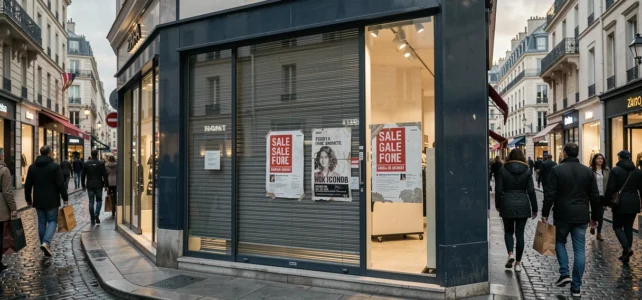
Zara is among the most prominent ready-to-wear brands in French city centers and shopping malls. The reduction in the number of its retail outlets, initiated several years ago by its parent company Inditex, is gradually changing the retail landscape of fashion in France. This movement does not indicate a withdrawal from the market, but rather a profound reorganization whose effects impact commercial landlords, competing brands, and consumers alike.
Inditex’s consolidation strategy: fewer stores, more space
To understand the closures of Zara stores, one must first grasp the industrial logic behind them. Inditex has reduced its global portfolio by 103 net stores in the 2025 fiscal year, while planning for approximately 5% growth in its gross commercial space in 2026 through expansions and renovations.
The group is closing or merging stores deemed too small or poorly located, to concentrate its resources on larger, better-placed stores that are more integrated with e-commerce. In Toulouse, for example, Zara closed one of its historic stores on rue Alsace-Lorraine, a location that, according to the brand, “no longer made sense” in its current configuration.
The closure of Zara stores in France is therefore part of a strategy to upscale physical retail locations, not a disengagement from the territory. Inditex is betting on flagships capable of offering a hybrid customer experience between store and digital.

Zara’s closure in city centers: the domino effect on commercial areas
When a well-known brand like Zara leaves a location, the consequences go beyond the mere vacancy of a space. The departure of a commercial anchor alters customer flows throughout an entire street or shopping center.
In Saint-Nazaire, the announced departure of Zara, Bershka, Pull and Bear, and Stradivarius from the Ruban Bleu shopping center illustrates this phenomenon. Four brands from the same group closing simultaneously represents a significant loss of space and a negative signal for other tenants.
What landlords and local authorities lose
Commercial landlords are left with often very large spaces that are difficult to re-rent in a tight physical retail market. Local authorities see their commercial attractiveness diminish, which can impact the overall foot traffic in a city center or shopping gallery.
- Prolonged vacancy of large commercial spaces, sometimes for several quarters, due to a lack of tenants capable of occupying such large premises
- Decrease in foot traffic for neighboring businesses that benefited from the traffic generated by Zara
- Downward pressure on commercial rents in the affected areas, which undermines the profitability of real estate projects
Zara’s departure acts as a revealing factor of the vulnerabilities of physical retail in medium-sized cities and suburban shopping centers. Metropolises generally retain their flagships, while secondary cities bear the brunt of closures.
Anti-fast fashion law in France: regulatory pressure reshuffling the cards
France has adopted legislation directly targeting the economic model of fast fashion. Starting September 1, 2026, financial penalties will apply to textiles sold at very low prices, with penalties reaching several euros per item.
This law primarily targets ultra-fast fashion platforms like Shein and Temu, whose prices defy all competition thanks to minimal cost production and manufacturing chains. Zara, although regularly associated with fast fashion, positions itself in a slightly higher segment in terms of price and perceived quality.
Zara caught between two worlds
The French regulation places Zara in an ambiguous position. The brand is not directly targeted by the heaviest penalties, but it faces competitive pressure from online platforms that are capturing an increasing share of the low-priced textile market.
The Inditex model relies on rapid collection turnover and vertical integration of production. This structure allows it to absorb regulatory changes more easily than less integrated French brands, several of which have faced financial difficulties in recent years.
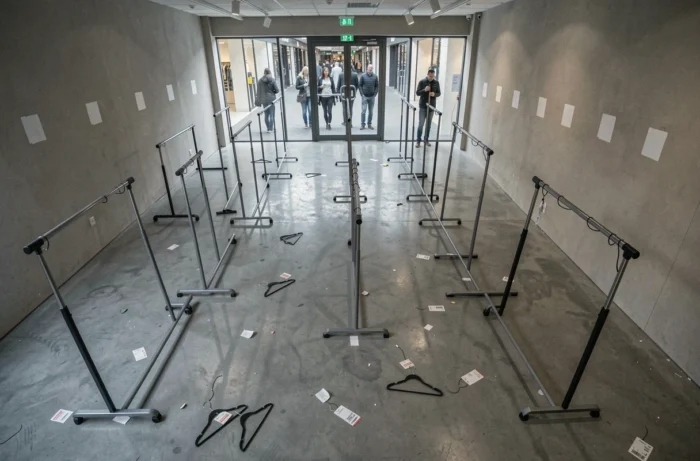
Consequences for French fashion brands and the textile market
Zara’s restructuring in France is not happening in a vacuum. The French clothing sector is undergoing a period of accelerated transformation, marked by the rise of e-commerce and the erosion of in-store margins.
Several historic French brands have already reduced their number of retail outlets or have entered collective proceedings. Zara’s departure from certain locations does not necessarily offer them an opportunity for recovery: the freed-up spaces are often too large, and rents remain high.
- Mid-range French brands struggle to compete with Inditex’s logistical responsiveness, which refreshes its collections in a matter of weeks
- The shift of customers to e-commerce is accelerating, including for textile purchases that were once made in-store
- Brands that survive are investing in experiential store concepts, smaller but with higher added value
Competition is no longer about the number of stores but about productivity per square meter and the ability to integrate online sales. Inditex understood this shift before many French textile players.
Textile production and employment in France
The closures of Zara stores do not have a direct impact on French textile production, as almost all the clothing sold by the brand is manufactured outside the country. The effect on employment is concentrated on in-store sales positions and local logistics.
Inditex generally indicates that it offers redeployment within the group during closures, particularly to remaining stores or e-commerce warehouses. The reality of these redeployments varies depending on employment areas and the geographical proximity of other retail locations.
The fashion sector in France is undergoing a structural adjustment. The closures of Zara stores are a visible symptom of this, but the underlying trend concerns the entire physical textile retail sector. The brands that will succeed will be those capable of combining a streamlined network of stores, a strong digital presence, and a rapid adaptation to new regulatory constraints on fast fashion.