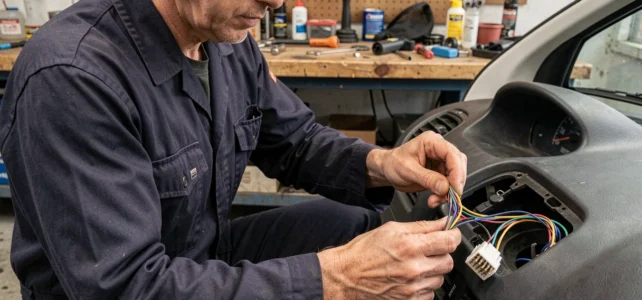
Replacing the original car radio of a Peugeot 206 is often the first encounter with a bunch of multicolored wires coming out of the dashboard. Each color corresponds to a specific function, and a misconnection can blow a fuse, damage a speaker, or simply prevent the unit from memorizing your stations. Understanding the color code of the harness before touching any connector avoids most of the problems encountered on forums.
CAN Bus and Steering Wheel Controls on Peugeot 206: What Changes the Wiring
Before discussing the wires one by one, it is important to know what type of harness is behind your unit. On 206 models produced from 2003-2004 onwards, Peugeot gradually introduced a multiplexed network. Specifically, some functions (display, steering wheel controls) no longer use traditional wires identifiable by color, but rather a digital data bus.
Why is this a trap? Because if you connect an Android car radio or an aftermarket unit relying solely on the standard color chart, the steering wheel controls may not respond. The management of these controls then goes through a CAN box interposed in the harness, which translates the digital frames into signals usable by the new car radio.
If your steering wheel buttons stop working after installation, the reflex is to check the permanent power (B+) and accessory power (ACC) of the harness, then disconnect and reconnect the CAN box to isolate the fault. On a non-multiplexed 206 (generally before 2003), this problem does not occur: the steering wheel control wires are directly connected and identifiable by their color.
To find the wiring diagram for the Peugeot 206 car radio color wires suitable for your configuration, you must first determine whether your vehicle is multiplexed or not. The production year and the presence of a multifunction display on the dashboard are the two most reliable clues.
Power Wire Color Code on the ISO Connector for Peugeot 206
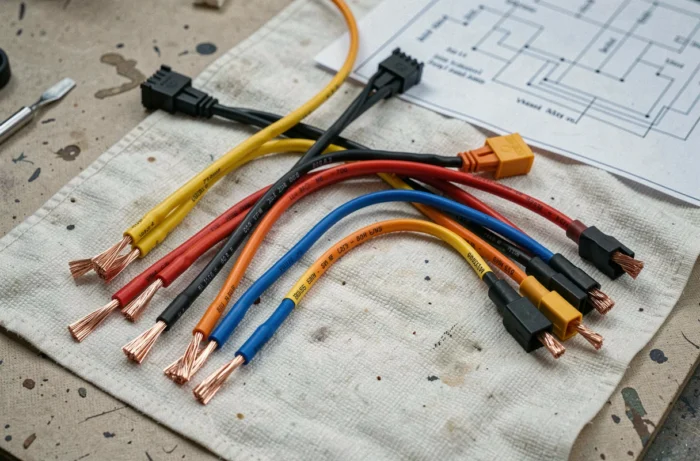
The ISO connector located behind the unit slot consists of two blocks: a power block and a speaker block. It is the power block that concentrates the most frequent errors.
The Three Wires to Identify as a Priority
- Yellow wire: permanent power (B+). It remains powered even when the ignition is off. This wire allows the car radio to remember your stations, settings, and the time. If you confuse it with another, the unit will reset every time you start the engine.
- Red wire: accessory power (ACC). It receives current only when the ignition key is in the accessory or on position. This is the wire that turns the unit on and off with the ignition.
- Black wire: ground. It ensures the return of current to the body. A poor connection on this wire can cause noise, sound dropouts, or prevent the car radio from starting.
The classic mistake on the 206 is to swap the yellow (permanent) and red (ACC) wires. The unit will then work with the ignition, but lose all memory as soon as you turn off the engine. On some forums, 206 owners also report a “yellow and green” wire that shows zero volts on the multimeter when it should be permanently powered. In this case, check the fuse dedicated to the car radio in your fuse box before suspecting a cut wire.
Blue Wire and Orange Wire: Two Often Ignored Functions
The blue wire controls the radio antenna (and GPS if your unit has one). Without this connection, FM reception can be very poor or even nonexistent. The orange wire, on the other hand, manages the brightness variation of the unit based on the dashboard lighting. On a 206, it is sometimes absent from the original harness if the vehicle was equipped with a basic car radio.
Connecting Speakers on Peugeot 206: Pairing the Right Wires
The second block of the ISO connector concerns the speakers. Each speaker uses a pair of wires: one positive and one negative. Reversing the polarity of a single speaker will not destroy it, but will cause a phase opposition. You will hear a hollow sound, lacking bass, as if the music is coming from afar.
Have you ever noticed that the sound seems to “disappear” when you turn up the volume? This is often a sign of a speaker wired in phase opposition to the others.
On the 206, the colors follow a pairing logic:
- Gray (positive) and gray/black (negative) for the front left
- White (positive) and white/black (negative) for the front right
- Purple (positive) and purple/black (negative) for the rear left
- Green (positive) and green/black (negative) for the rear right
The negative wire of each pair carries the same color as the positive, with a black stripe to mark the reverse polarity. If your harness has been modified by a previous owner (cut wires, connections with terminal blocks), a continuity test with a multimeter remains the only reliable way to find each pair.
ISO Adapter or Direct Connection: Which Choice for the 206
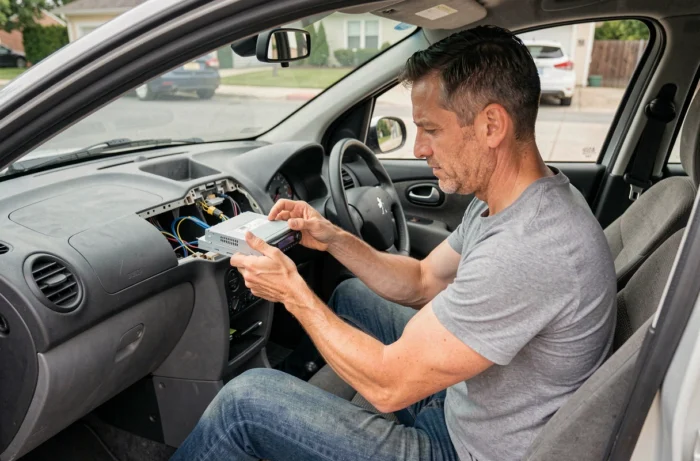
Connecting wire to wire by twisting and insulating with electrical tape works, but weakens the installation. A specific Peugeot ISO adapter cable connects on one side to the vehicle’s original connector and on the other side to the standard ISO plug of your new car radio. No wire cutting, no soldering.
The main advantage is reversibility. If you sell the car or change the unit again, the original harness remains intact. On a multiplexed 206, the adapter sometimes includes the CAN box necessary for the steering wheel controls, which significantly simplifies the operation.
A clean installation on a 206 generally takes less than an hour with an ISO adapter and a wiring diagram in hand. Without an adapter, expect to take twice as long, especially if the harness has been modified. Always check the permanent power and ground with a multimeter before clipping the unit into its slot: this is the test that prevents you from having to disassemble everything a second time.