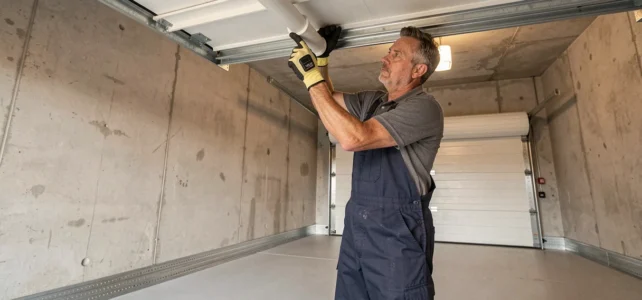
A garage with a low lintel, a ceiling cluttered with pipes, or a limited setback space: it is often in these configurations that the roll-up garage door becomes the only viable option. Its aluminum slat curtain rolls up into a compact box fixed above the opening, freeing up the entire ceiling and side walls.
Before starting the work, it’s worth checking a few technical points that the installation manuals do not always detail.
Support Constraints and Measurements for a Roll-Up Door
The first thing to inspect is not the door: it’s the wall. A hollow block lintel does not attach like a solid concrete lintel. If the anchors do not hold in the support, the roll-up box will end up vibrating with each operation, and the slats of the curtain will misalign within a few months.
Measure the width of the frame at three different heights (bottom, middle, top) and the height on both sides. A difference of more than one centimeter between the two sides requires shimming the tracks, or else the curtain will rub. The lintel must provide sufficient depth to accommodate the roll-up box, which varies according to the number of slats and their thickness.
Also check the immediate environment: electrical cables, downspouts, junction boxes. Any obstacle in the area of the box or tracks must be moved before installation. This is a point that experienced installers identify during the preliminary technical visit, and it can change the type of installation chosen (inside, outside, or under the lintel).
For those who wish to have a roll-up garage door installed by Terre de Breizh, this site diagnosis step is detailed in their guide, which also covers renovation cases on existing structures.
Motorization and Safety of a Motorized Garage Door
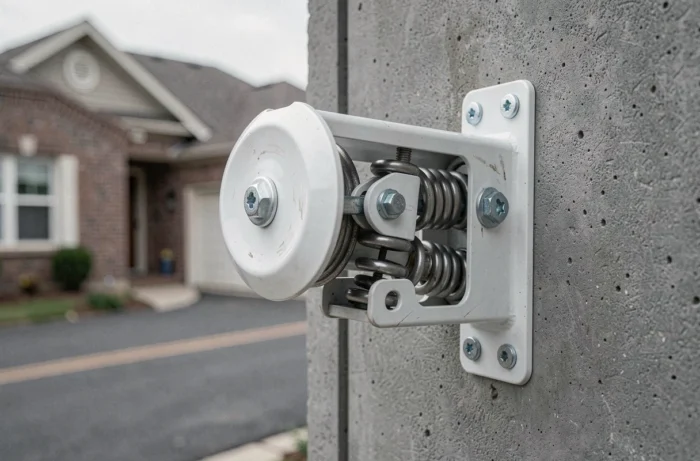
Almost all roll-up doors sold today are motorized. The tubular motor is housed directly in the winding axis, which explains the compactness of the system. Two parameters determine the choice of motor: the total weight of the curtain and the frequency of daily use.
An undersized motor wears out quickly and triggers breakdowns as early as the second year. Manufacturers indicate a number of cycles per day (one opening + one closing = one cycle). For typical residential use, it rarely exceeds ten cycles, but a garage also used as a workshop or professional space can double this figure.
Mandatory Safety Devices
A motorized roll-up garage door is both a construction product (standard EN 13241) and a machine under the Machinery Directive. It must therefore bear a CE marking accompanied by a declaration of performance and a declaration of conformity.
In practice, the safety devices to check before commissioning are as follows:
- An obstacle detection system (sensitive edge, photoelectric cells, or force detection on the motor) that stops and reverses the movement of the curtain in case of contact with a person or object.
- A fall prevention device that blocks the curtain if the strap or compensation spring fails, to prevent a sudden drop.
- An accessible manual release from the inside, allowing the door to be operated in case of a power outage.
Without these three elements, the door is not compliant and the installer is liable. If you purchase the door separately to have it installed later, ensure that the kit includes these components.
European Regulation 2024/3110 and Compliance of Your Installation
Since January 8, 2026, the regulation (EU) 2024/3110 is gradually replacing the old regulation 305/2011 on construction products. For a roll-up garage door, this translates into strengthened obligations for traceability and technical documentation on the part of the manufacturer.
Specifically, upon receiving your door, you must obtain two distinct documents: the declaration of performance (related to the construction products regulation) and the CE declaration of conformity (related to the Machinery Directive). Keep these documents for the entire lifespan of the door, as they condition the warranty and potential resale of the property.
Feedback varies on this point, but some installers do not spontaneously provide these documents. It is recommended to explicitly request them before the final payment for the service.
Maintenance of an Aluminum Roll-Up Garage Door
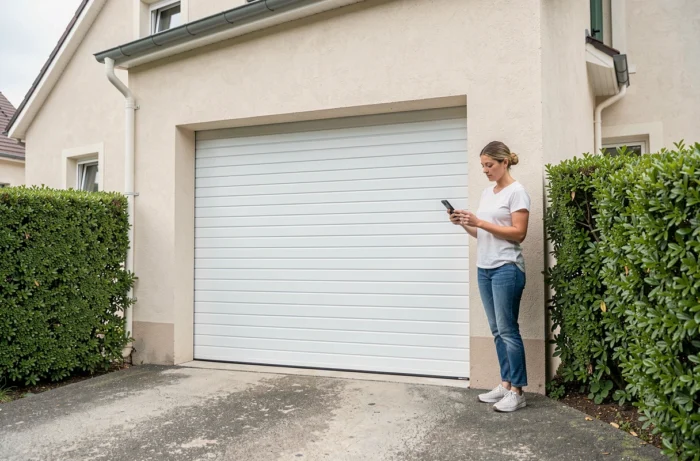
An aluminum curtain does not rust, but it accumulates dust and debris in the tracks. If the rails are not cleaned at least twice a year, the slats rub more, the motor strains, and electricity consumption increases without the problem being visible.
Here are the points to check regularly:
- The condition of the side seals and the bottom seal: a crushed or detached seal allows air and water to pass through, reducing the insulation of the garage.
- The proper functioning of the obstacle detection system: place an object (a rigid cardboard will suffice) in the path of the curtain to check that the door stops and reverses.
- The tension of the strap or compensation spring: a loosening changes the effort required by the motor and can cause an unexpected safety stop.
- The lubrication of the axles and guides according to the manufacturer’s recommendations (some double-walled aluminum curtains do not require any lubrication of the slats themselves).
An annual inspection by a professional remains the most reliable method to detect wear on mechanical parts before they cause a complete breakdown. Some installers offer maintenance contracts that include an annual visit and replacement of wear parts.
The aluminum curtain withstands light impacts well, but a deformed slat must be replaced individually. This is one of the advantages of the roll-up system compared to a single-panel door: you can change the affected slat without disassembling the entire door, which limits repair costs over time.