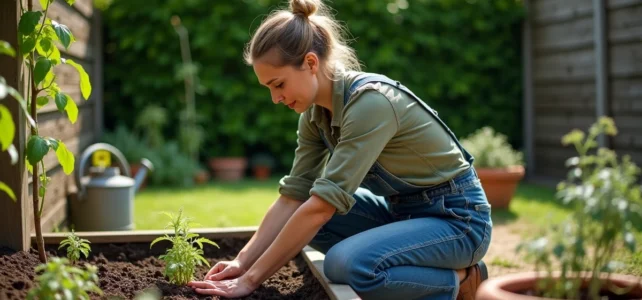
Your tomatoes have yellowing leaves, your salads are riddled with holes, and the bag of chemical fertilizer in the garage no longer inspires confidence. Organic gardening often starts with this observation: synthetic products solve a visible problem while creating others, less obvious, in the soil and the food chain. Growing a healthy and natural vegetable garden requires a change in mindset, not more work.
Adapting Your Organic Vegetable Garden to Water Restrictions
Articles on organic gardening often talk about mulching and composting. They rarely address the constraint that is increasingly weighing on vegetable gardens: watering restrictions due to recurring droughts.
For several summers, drought orders have multiplied in France and Belgium. Watering of private gardens is regularly limited or prohibited during the hottest months. An organic vegetable garden that relies on a hose remains fragile in the face of this reality.
Have you noticed that some vegetable beds fare better than others during a heatwave? The difference rarely comes from the variety alone. It comes from the soil. Soil rich in organic matter retains water like a sponge, while bare, compacted earth lets every drop slip away. The response from a reference site like Jardinage Bio starts with the permanent coverage of the soil: mulch made of hay, dead leaves, or dried grass clippings.
Grouping water-hungry plants (tomatoes, zucchinis, cucumbers) in the same area facilitates targeted watering. Drought-resistant vegetables (garlic, onions, thyme, dry beans) occupy separate beds, watered less frequently. This logic of zoning by water needs reduces overall consumption without sacrificing yields.
- Install one or more rainwater collectors connected to the gutters to create a reserve outside of rainy periods.
- Water early in the morning or late in the day, never in full sun, to limit evaporation.
- Use living ground covers (white clover, purslane) between rows of vegetables to retain moisture and protect the soil.
Living Soil in the Vegetable Garden: Nourishing the Soil Rather Than the Plant
In conventional gardening, plants are fed with soluble fertilizers. In organic gardening, the soil is nourished. This distinction changes everything.
A living soil contains billions of microorganisms: bacteria, fungi, earthworms. They are the ones that decompose organic matter and transform it into nutrients that can be absorbed by the roots. Without this underground life, even the best compost remains ineffective.
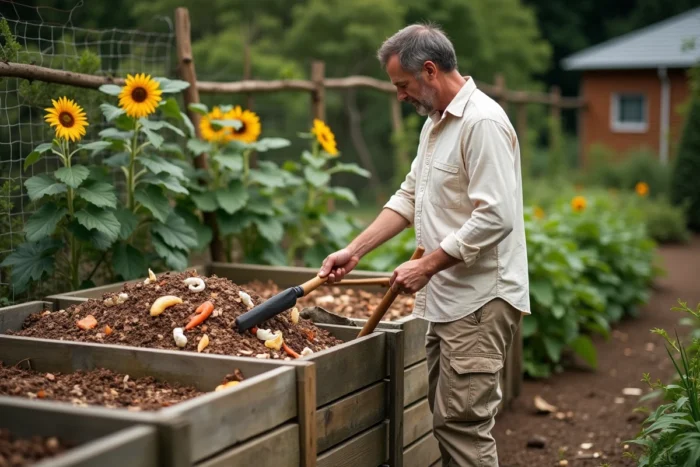
Homemade compost is the foundation. Vegetable peels, coffee grounds, crushed eggshells, dead leaves: these waste materials become a rich and balanced amendment in a few months. Spread on the surface in the fall or early spring, it feeds the soil’s microfauna without disturbing it.
Avoid Deeply Turning the Soil
Deep digging, long considered a basic gesture, disrupts the layers of soil. It exposes anaerobic microorganisms to air and buries those that live on the surface. The result: soil life takes weeks to regenerate.
The grelinette or fork-spade, pushed down and tilted without turning the clod, aerates the soil without destroying its structure. Aerating the soil without turning it preserves the mycorrhizal networks that connect plant roots to each other and facilitate nutrient absorption.
Natural Products in the Vegetable Garden: What is Allowed and What is Not
Many gardeners believe that any plant-based product is automatically allowed in organic gardening. This is no longer the case.
European regulations have evolved in recent years. Some plant preparations sold as “natural” are now subject to the same authorization procedures as conventional phytosanitary products. A product can be of natural origin and still be banned from sale or use if it has not received approval.
Nettle manure, for example, is recognized as a stimulant and can be prepared at home for personal use. However, preparations based on rotenone (derived from tropical plants) have been removed from the market for several years due to their proven toxicity, including to beneficial insects.
Effective Natural Treatments
Diluted black soap remains effective against aphids. It works by contact, clogging the respiratory pathways of insects, without chemical residue. Baking soda, sprayed in a light solution, limits the spread of powdery mildew on cucurbits and vines.
Why prioritize these simple solutions? Because they target a specific problem without disrupting the entire ecosystem. A copper treatment (Bordeaux mixture), although tolerated in organic gardening, accumulates in the soil over the long term. Reducing copper doses protects the microbial life of the soil.
Beneficial Insects and Crop Associations for a Natural Vegetable Garden
An effective organic vegetable garden is based on a simple principle: let natural predators do the work for you.
Ladybugs devour aphids. Hoverflies, those small flies that hover, lay their larvae directly in aphid colonies. Ground beetles, black beetles that live in the soil, hunt slugs and snails at night. To attract these beneficial insects, you need to provide them with habitat: a diverse hedge, a pile of wood, a strip of wildflowers along the edge of the garden.
- Plant nectar-rich flowers (phacelia, borage, marigold) between rows of vegetables to attract pollinators and pest predators.
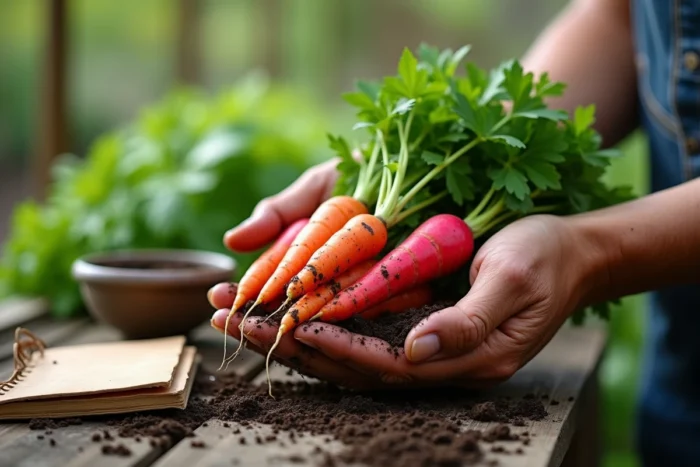
- Pair tomatoes with basil, which repels certain insects, and carrots with leeks, whose overlapping scents deter their respective pests.
- Leave some “wild” areas in the garden: tall grasses, nettles at the edge, flat stones placed on the ground to shelter lizards and toads.
Crop associations reduce disease pressure by avoiding large areas planted with a single species. A monoculture of zucchinis massively attracts the same pests. A mix of vegetables, herbs, and flowers confuses the olfactory and visual signals of harmful insects.
Adopting an organic vegetable garden is not just about eliminating chemical products. It is a change in perspective: accepting a few nibbled leaves, observing before intervening, betting on living soil rather than treatment. The first seasons require a learning period. But a garden where beneficial insects settle, where the soil naturally structures itself, ultimately requires fewer interventions than a garden on chemical life support.