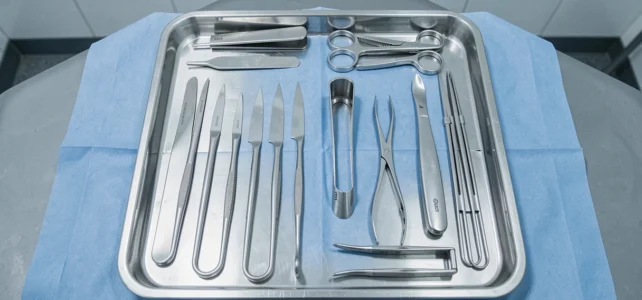
The quality of a surgical procedure relies as much on the practitioner’s skill as on the reliability of their instruments. Each surgical tool serves a specific function in the operative chain, from the initial incision to the closure of tissue layers. Understanding the metallurgical specifics, regulatory constraints, and selection criteria for this surgical equipment helps optimize safety in the operating room and the durability of investments.
Stainless Steel and Alloys: What Metallurgy Changes in the Operating Room
A surgical instrument is not just a simple metal object. The type of stainless steel used directly determines corrosion resistance, edge hardness, and longevity after hundreds of autoclave cycles.
Martensitic steels (such as AISI 420 or 440) are preferred for scalpel blades and surgical scissors. Their higher carbon content allows for fine sharpening and superior edge retention. In contrast, austenitic steels (such as AISI 304 or 316L) are better suited for clamps and retractors, where corrosion resistance takes precedence over sharpness.
The choice of alloy determines the instrument’s lifespan and performance. A poor match between steel type and function leads to premature wear, micro-cracks, or cross-contamination during sterilization. We recommend systematically checking the material certification with the manufacturer before any acquisition.
To learn everything about surgical equipment and its various categories, one must first master this metallurgical foundation, which is too often overlooked in hospital purchasing guides.
Functional Classification of Surgical Instruments
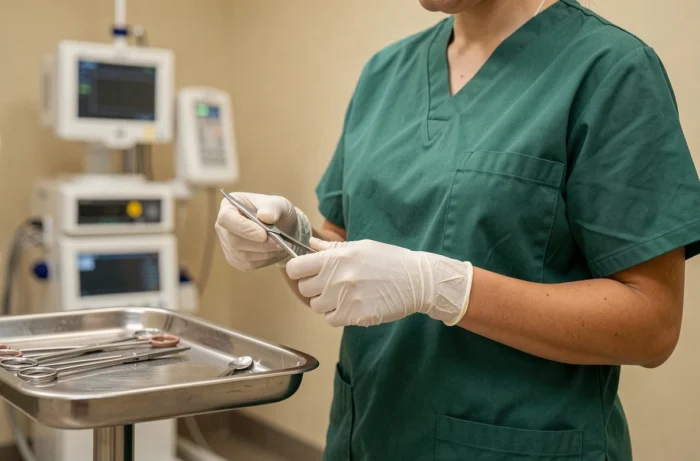
Rather than an exhaustive list, we highlight the four functional families that truly structure an operating tray in general surgery.
Dissection Instruments: Scalpel, Scissors, Dissector
Dissection encompasses all cutting and dissection tools. The interchangeable blade scalpel (handle no. 3 for blades 10 to 15, handle no. 4 for blades 20 to 25) remains the reference for skin incision. Mayo scissors, whether straight or curved, ensure the cutting of thick tissues, while Metzenbaum scissors, being finer, are used for dissecting delicate anatomical layers.
The choice between cold blade and electric scalpel depends on the targeted tissue layer and the hemorrhagic risk. The cold blade offers a clean cut with less lateral thermal necrosis, an advantage in plastic or ophthalmic surgery.
Grasping Instruments: Dissecting and Grasping Forceps
The dissecting forceps without teeth (such as Debakey type) handle fragile tissues, particularly vessels and serous membranes. The grasping forceps (such as Adson type) grip the skin and aponeuroses more firmly. Using an inappropriate forceps for the tissue increases the risk of iatrogenic injury.
Hemostasis Instruments and Retractors
Hemostatic clamps (Kocher, Kelly, Halsted) allow for temporary or permanent vascular clamping. Their jaws can be straight or curved, smooth or serrated, depending on the caliber of the targeted vessel.
Retractors (Farabeuf, Langenbeck, self-retaining types like Balfour) expose the surgical field. A poorly sized retractor compromises visibility and prolongs the surgical time.
Suture Instruments and Associated Anesthesia Equipment
Needle holders (Hegar, Mathieu) complete the closure chain with absorbable or non-absorbable sutures. The choice of suture material depends on the tissue (monofilament to reduce infection, braided for knot strength).
- Synthetic absorbable suture (such as polyglactin): absorption within a few weeks, suitable for deep layers and mucous membranes
- Non-absorbable suture (such as polypropylene): requires removal, preferred for skin and vascular structures
- Skin staples: quick closure in digestive or orthopedic surgery, with a healing rate comparable to traditional sutures
Anesthesia equipment (laryngoscope, intubation tubes, breathing circuits) does not strictly belong to the surgical tray, but its condition affects perioperative safety just as much as dissection instruments.
MDR Regulation and Traceability of Surgical Instruments in Europe
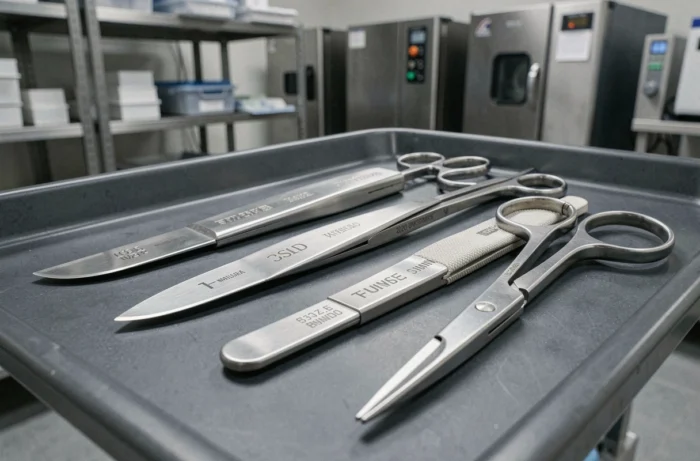
Reusable surgical instruments now require the intervention of a notified body for CE marking under the European MDR regulation (EU 2017/745). This evolution brings their regulatory burden closer to that of higher-class devices (IIa, IIb, III).
Since May 2026, four EUDAMED modules have become mandatory for manufacturers and distributors of medical devices, including surgical instruments:
- Registration of economic operators (manufacturer, authorized representative, importer)
- Registration of devices with UDI (Unique Device Identification)
- Declaration of CE certificates
- Market surveillance and vigilance
In practice, each reference of scalpel, forceps, or scissors must be registered with a UDI and traceable in case of an incident. An instrument without a UDI registered in EUDAMED should no longer be placed on the European market.
We observe that many establishments continue to acquire instruments from suppliers that are not yet compliant with these requirements. Verifying the regulatory status of the manufacturer (EUDAMED registration, valid notified body certificate) is now part of the purchasing prerequisites, just like material compliance.
Maintenance and Sterilization: Extending the Lifespan of Surgical Equipment
A well-maintained instrument can last several years of service. Neglect at this stage generates hidden costs far exceeding the initial purchase price.
Immediate enzymatic cleaning after use prevents the fixation of protein residues. Thorough drying before autoclaving prevents pitting corrosion, even on stainless steels known for their resistance. Ratchet forceps must be sterilized in the open position to avoid shadow areas that steam cannot reach.
Systematic visual inspection (alignment of jaws, integrity of scissors, absence of joint play) should precede each reassembly of the tray. A defective instrument put back into circulation poses a risk to the patient and a traceability failure regarding the MDR.
The lifespan of an instrument depends as much on its initial quality as on the reprocessing protocols applied. Facilities that invest in training sterilization staff see a significant reduction in the replacement rate of their instrument inventory.