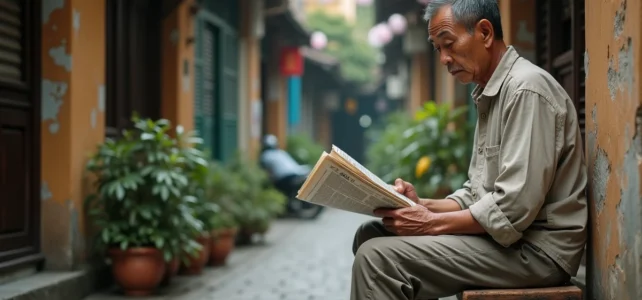
Guangzhou is not just about the Canton Tower, Shamian Island, or the Chen Clan Temple. These points of interest deserve a visit, but the true density of the city is found in its urban villages embedded in the metropolitan fabric, its neighborhood markets, and its streets where Cantonese remains the language of transaction, not Mandarin.
Urban Villages of Guangzhou: Shipai and Xiaozhou as Interpretative Grids
The concept of cunwei (urban village) has no equivalent in Europe. These are historic village cores absorbed by the expansion of the metropolis, which retain their original street layout, low buildings, and a local economy completely detached from the surrounding malls.
Shipai is the largest urban village in Guangzhou, nestled in the Tianhe CBD. Just a few hundred meters from the office towers, the alleys are organized into a dense network, with informal housing, eateries, hair salons, and repair shops. The visual gap between Shipai and its immediate environment encapsulates contemporary Chinese urbanization.
The ancient village of Xiaozhou, by the water, offers a different perspective. The village layout is better preserved here, with canals, gray brick houses, and an artistic activity linked to the presence of workshops.
Combining these two villages in one day allows you to grasp the contrast between accelerated urbanization and the persistence of old structures. Those who wish to explore Guangzhou differently will find in these neighborhoods a much richer experience than in the classic circuits focused on monuments.
Visa Exemption and 240-Hour Transit: What It Means Practically
As of December 17, 2024, China has unified the 240-hour visa-free transit nationwide. For a traveler on a connecting flight, this means several full days in Guangzhou without consular formalities, provided they meet the transit criteria.
Holders of a regular French passport also benefit from a visa exemption for stays of up to 30 days, extended until December 31, 2026. This regulatory window changes the logic of visiting: one no longer passes through Guangzhou on a quick transit; one can have a real stay focused on residential neighborhoods, local markets, and street food scenes.
We recommend checking the precise conditions before departure, as the visa-free transit rules impose constraints on entry and exit airports. Baiyun International Airport (CAN) is eligible, covering the vast majority of international flights to the Guangdong region.
Local Culinary Scene: Beyond Tourist Dim Sum
Guangzhou is recognized as the culinary capital of southern China. Cantonese cuisine is practiced here in a density of establishments that neither Hong Kong nor Shenzhen can match at this price level.
Dim sum remains a must-try, but the yum cha halls frequented by locals operate under different codes. They open early in the morning, practice cart service, and offer prices significantly lower than the restaurants listed in international guides. Looking for signs in characters only, without an English menu, remains the best filter.
Beyond dim sum, three categories deserve attention:
- Congee (rice porridge) offered in local versions with raw fish, offal, or century egg, served in stalls open from dawn
- Slow-cooked soups (lao huo tang), simmered for several hours with medicinal ingredients, ubiquitous in neighborhood canteens
- Cantonese wonton noodles, in their thin and dry version (not the broth version served in Hong Kong), with hand-pulled duck egg dough

Getting Around Guangzhou Without an Organized Tour
The metro network covers almost the entire city and remains the most efficient way to connect neighborhoods. Signage is bilingual in Chinese and English at all stations, making independent navigation perfectly feasible even without knowledge of Mandarin.
For urban villages and outlying markets, the complement comes from local ride-hailing apps. Didi operates in Guangzhou and accepts international card payments since recent updates. However, having an active VPN remains necessary to access Western services (Google Maps, WhatsApp).
Urban buses offer a finer network but require familiarity with the QR code payment system. For a first stay focused on neighborhood exploration, the combination of metro and walking largely covers the needs.
Neighborhoods to Target Based on Length of Stay
On a short stay (two to three days), we recommend focusing time on Tianhe (for Shipai and the CBD/village contrast), Liwan (old town, Shangxiajiu street, Qingping market), and Haizhu (Xiaozhou and the flower market).
For a longer stay, the Panyu district to the south is worth a detour. Here you find less frequented Cantonese villages, still-active lineage temples, and a street food scene distinct from that of downtown. The metro ride from Tianhe takes less than an hour.
- Tianhe: urban villages, local nightlife, shopping centers to observe Cantonese consumer culture
- Liwan: Xiguan architectural heritage, traditional markets, herbal shops
- Haizhu: Xiaozhou, Canton Tower (for the view, not for spending the day), Lingnan flower market
- Panyu: lineage temples, rural cuisine, slower pace
Guangzhou is better suited for neighborhood exploration than for a monument-by-monument itinerary. The alleys of Shipai, the yum cha halls without translated menus, or the markets of Liwan at dawn provide access to a contemporary Cantonese culture that the major observation platforms do not show.