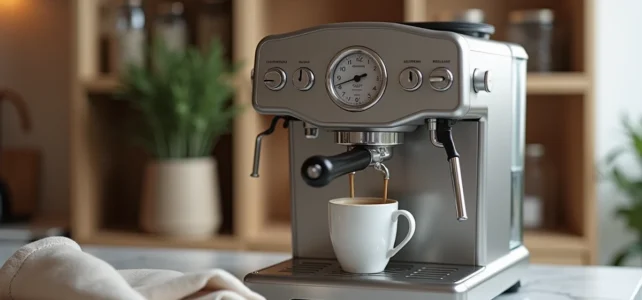
The nominal pressure displayed on the packaging of a domestic espresso machine says very little about the quality in the cup. A vibrating pump advertised at 15 bars rarely delivers more than 9 effective bars at the group, and it is precisely this pressure at the portafilter that conditions the extraction. We recommend considering this parameter as a disqualifying filter rather than a selling point.
Effective pressure and thermal stability: the parameters that product sheets hide
Almost all domestic machines use a vibrating pump (Ulka type or similar). This type of pump generates pulsed pressure, not a constant flow. Machines equipped with a rotary pump offer stable and quiet pressure, but their price increases significantly.
The second underestimated technical parameter is thermal stability. A thermoblock heats up quickly, cools down quickly, but oscillates. A brass or stainless steel boiler takes longer to reach the set temperature, then maintains it with much less variance. For multiple extractions, this thermal inertia becomes a real advantage.
On single boiler machines, switching from extraction to steam requires a purge and heating time. Double boiler machines eliminate this delay, which changes the daily practice for anyone preparing milk-based drinks. This is a criterion we consider more discriminating than the brand or design.
A complete catalog of references sorted by type of boiler and pump is available at machineaexpresso.fr, making it easier to filter before even comparing prices.
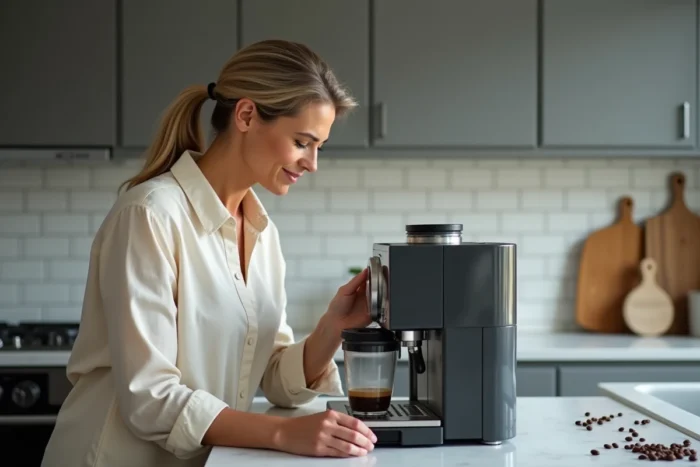
Dedicated or integrated grinder: the choice that weighs most on the cup
A semi-automatic machine paired with a quality separate grinder produces a noticeably better cup than a super-automatic at the same budget. This observation, shared by the majority of recent technical guides, is due to a simple reason: the freshness of the grind and the control of the grind size determine the extraction much more than the automation of the process.
The grinders integrated into super-automatics almost always use small diameter flat burrs, with step adjustments. A dedicated grinder with larger diameter conical or flat burrs allows for much finer adjustments, dose by dose.
Super-automatic: comfort versus precision
We observe that the super-automatic segment attracts with the promise of a single action. Beans in the hopper, button pressed, coffee in the cup. For family use with multiple drink profiles, this is a valid argument. The trade-off is a structurally lower quality ceiling and a maintenance cost (gaskets, brew group, automated descaling) often overlooked at the time of purchase.
Semi-automatic with separate grinder: the winning combination
The semi-automatic plus grinder tandem remains the reference for those aiming for quality in the cup. The total budget can be similar to that of a mid-range super-automatic, but the margin for improvement is incomparable. Each variable (dose, grind size, tamp, extraction time) is adjusted independently.
Lever machines for home: an alternative gaining ground
The lever machine segment is experiencing a marked resurgence of interest among discerning enthusiasts. Models like the Flair 58, Cafelat Robot, or La Pavoni Europiccola target domestic use with a pump-free, silent, and durable operation.
The principle is mechanical: the user operates a lever that pushes water through the coffee puck. The control of the pressure profile during extraction is total, which no domestic pump machine allows natively without modification or third-party accessories.
- Main advantage: no electronic parts or pump to replace, significantly extending the lifespan of the device.
- Major constraint: the learning curve is steep. Without a precise grinder and understanding of dosing, results are inconsistent.
- Footprint: these machines are often compact, suitable for small living spaces, a significant argument in urban environments.
This segment is not suitable for those seeking consistency without effort. It is aimed at users who consider coffee preparation as a technical gesture, not as a morning chore.
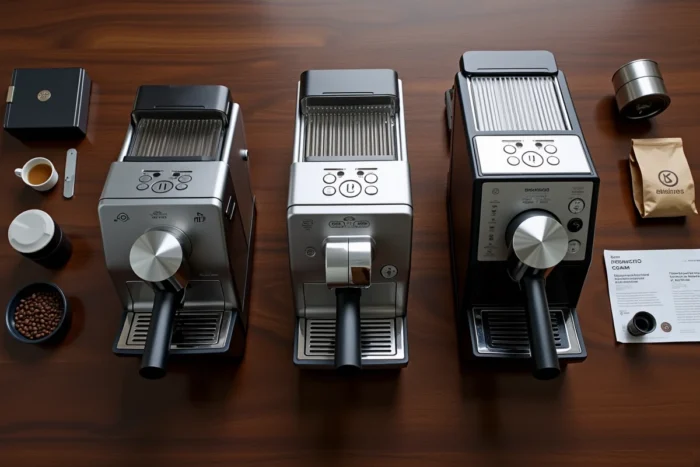
Filtration criteria and water quality: the overlooked weak link
Water represents more than 90% of the volume of an espresso. Water that is too hard clogs the boiler and alters the taste. Water that is too soft produces a flat extraction. The ideal hardness for espresso is in a moderate range, neither overly softened nor mineral-heavy.
We recommend testing the hardness of tap water with strips before any purchase. Depending on the result, three options arise:
- Direct tap water, if the hardness is moderate and chlorine filtered by a pitcher or inline filter.
- Filtered reverse osmosis water remineralized, for areas with very hard water.
- Bottled water with controlled mineralization, a simple but costly long-term solution.
Neglecting this parameter means investing in a high-performance machine and then restricting it. Regular descaling does not compensate for an unsuitable water profile: it limits mechanical damage, not the defect in the cup.
Domestic espresso: semi-automatic and separate grinder remain the most reliable combination
The market offers dozens of segments, from capsule models to semi-professional groups. For an enthusiast looking to improve, the semi-automatic plus dedicated grinder tandem offers the best quality-in-cup per euro spent. Lever machines provide a credible alternative for technical profiles, provided one is willing to learn. In any case, water quality and grind freshness weigh more than the brand name on the front of the machine.