
An antique mirror with spots poses a technical question before it becomes an aesthetic problem: should one attempt to restore the silvering, hide the flaws, or simply protect what remains? The answer depends on the type of degradation, the reflective material, and the environment in which the mirror has aged. Comparing these approaches allows for the selection of the most suitable method without wasting time or money.
Silvering, mercury, or modern treatment: adapting the method to the mirror
Online guides often offer a one-size-fits-all recipe for all spotted mirrors. This approach overlooks a fundamental distinction: the type of silvering dictates the choice of technique.
A mirror made before the 19th century may contain mercury in its reflective layer. This compound, long banned due to its toxicity, requires special precautions: strong ventilation, wearing gloves and a mask, and minimal handling. Applying white vinegar or a mild abrasive to this type of surface can worsen the damage instead of correcting it.
More recent mirrors use a silvering protected by a layer of paint on the back. On these models, black spots indicate localized oxidation of the silver, often caused by moisture seeping in from the edges. Before any intervention, it is useful to know how to restore an antique spotted mirror by first identifying the exact nature of the reflective layer.
Some contemporary mirrors incorporate an anti-fog or anti-reflective treatment. These surfaces do not tolerate acids or abrasive products: cleaning with white vinegar, although recommended everywhere, can irreversibly damage the coating.
| Type of mirror | Reflective layer | Products to avoid | Recommended approach |
|---|---|---|---|
| Antique (pre-19th) | Mercury | Acids, abrasives, solvents | Minimal intervention, glassmaker if heritage value |
| Classic (19th-20th) | Silver + protective paint | Strong abrasives | Targeted touch-up of the silvering or camouflage |
| Modern treated | Silver + anti-fog/anti-reflective | Vinegar, ammonia, abrasives | Neutral cleaning, no restoration of the silvering |
Humidity and unprotected edges: the real cause of spots on a mirror
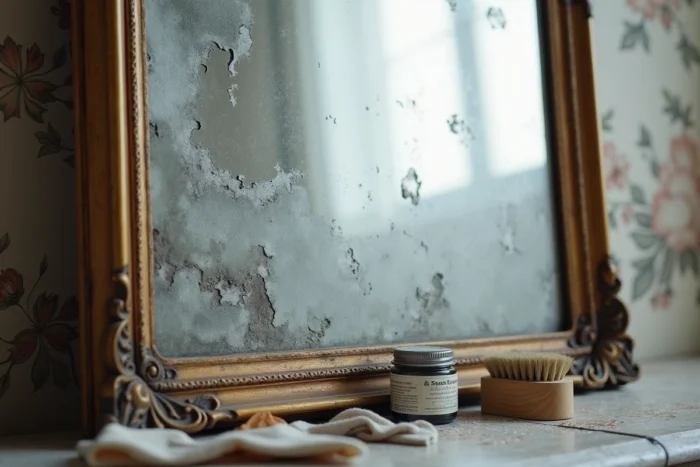
Humidity remains the main cause of degradation of the silvering on most antique mirrors. Water does not penetrate through the visible surface, but through the edges and the back, where the protective paint layer is absent or cracked.
A mirror hung in a bathroom without effective air extraction develops spots within a few years. The same mirror, placed in a dry room with its edges properly sealed, can remain intact for decades.
Edge protection: an underestimated gesture
Prevention starts with treating the edges of the mirror. Applying marine varnish to the edge and back creates a barrier against moisture. This step, rarely mentioned in restoration tutorials, extends the lifespan of the silvering far more than regular cleaning.
- Apply two coats of clear varnish to the edges and back of the mirror, allowing to dry between each coat
- Check that the frame does not retain condensation water in contact with the glass
- Avoid mounting an antique mirror directly against a damp wall, leaving a few millimeters of air space at the back
- Inspect the condition of the edges once or twice a year, especially in rooms exposed to steam
If spots already exist, sealing the edges stops the progression of oxidation even without restoring the damaged areas. This is the first intervention to be carried out.
Touching up the silvering or decorative camouflage: comparing the two options
Once the spots are established, two strategies oppose each other. Touching up the silvering aims to reconstruct the reflective surface on the damaged areas. Decorative camouflage accepts the flaws and integrates them into the mirror’s aesthetic.
Partial touch-up of the silvering
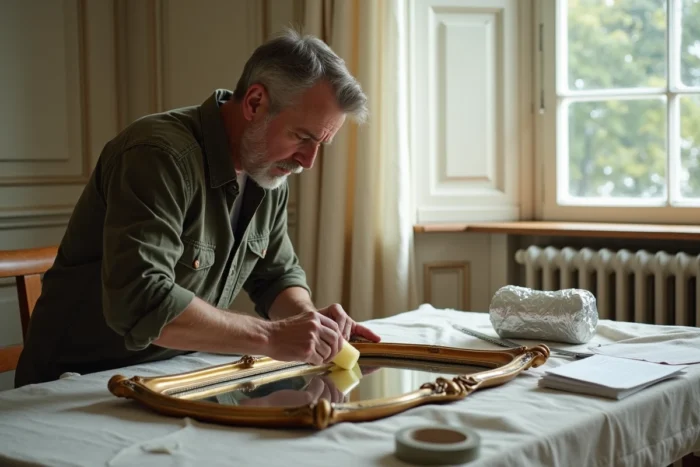
The technique involves working on the back of the mirror. After carefully removing the protective paint and residues of oxidized silver from the spotted area, an aluminum or silver foil is applied with an appropriate adhesive. The result remains visible up close, as the reconstructed silvering never has the same uniformity as the original.
This method is suitable for small isolated areas. On a heavily spotted mirror, the multiplication of touch-ups creates a less satisfying patchwork effect.
Camouflage and highlighting of flaws
The alternative is to cover the spotted areas with a custom-made wider frame, a decorative border painted directly on the glass, or a composition of patterns that transforms the flaws into a decorative element. This approach has a practical advantage: professional restoration of the silvering can cost more than a standard new mirror.
A uniformly spotted mirror, with its stains distributed organically, has a charm that some decorators intentionally seek. In this case, a simple gentle cleaning (warm water and microfiber cloth, without acidic product) is enough to revive the surface without altering its character.
Cleaning an antique spotted mirror: suitable products
Cleaning is often the only intervention needed to restore shine to an antique mirror. Diluted white vinegar remains effective on a classic silvered surface, provided it is never allowed to run onto the edges or back of the mirror.
- Mix one part of white vinegar with three parts of warm water, applying with a soft cloth without excess liquid
- On an antique mirror with heritage value, limit to a slightly damp microfiber cloth, without any chemical product
- Never spray directly on the surface: soak the cloth, then wipe
Cleaning does not restore the silvering, it improves the transparency of the glass. A properly cleaned mirror appears less spotted because surface deposits disappear, but the underlying oxidation remains in place.
The distinction between a mirror that deserves restoration and one that benefits from simply being cleaned and protected depends on its value, the extent of the spots, and the available budget. For the majority of mirrors found at flea markets, sealing the edges and cleaning the glass provides a sufficient result without risking altering a fragile piece.