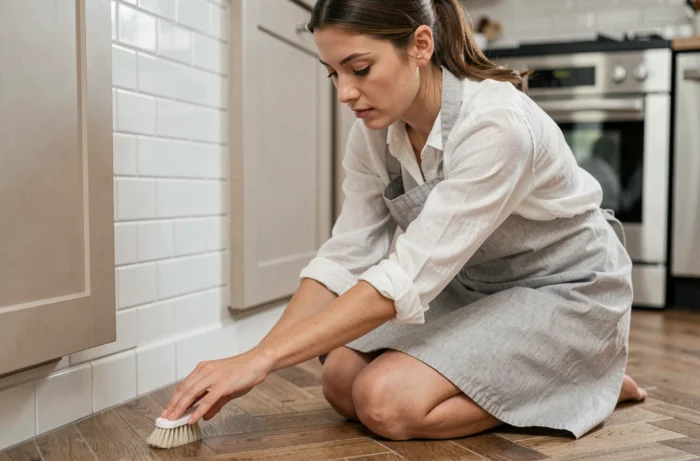
The daily cleaning of a house relies less on the time spent and more on understanding what actually dirties and what cleans without causing harm. Dust, cooking grease, residues from household products themselves: each source of dirt calls for a precise response. Approaching cleaning from this technical angle allows for reduced effort while achieving a sustainably clean interior.
Indoor air pollution from scented household products
A common reflex is to associate the smell of cleanliness with successful cleaning. Research presented in August 2026 at the American Chemical Society by Brandon Boor’s team from Purdue University sharply questions this idea.
Terpene-based fragrances (lemon, pine, synthetic lavender), found in most scented cleaners, react with the ozone naturally present in indoor air. This chemical reaction generates ultrafine nanoparticles capable of reaching the deep areas of the respiratory tract. According to this research, the respiratory dose can equal that measured near a heavily trafficked road.
In practical terms, multiplying sources of fragrance in the same room (air freshener spray, scented floor cleaner, scented wipes) degrades the air quality that one was trying to purify. The recommendations from this research are straightforward: prioritize unscented products, ventilate during and after cleaning, and avoid using ozone-generating devices (some purifiers, UV-C lamps) during cleaning.
Resources like leguidedunettoyage.fr help better identify compositions to avoid and choose cleaning products suitable for daily use without risk to indoor air.

White vinegar, baking soda, and black soap: knowing when to use each product
Three products come up in all discussions about natural cleaning. Their actual effectiveness depends on the type of dirt targeted, and confusing them is a waste of time.
- White vinegar acts on limescale and has antibacterial properties. It is suitable for descaling a kettle, rinsing a dishwasher, or cleaning windows. However, it has no degreasing power and should never be applied to marble or natural stone, which it attacks due to its acidity.
- Baking soda is a mild abrasive and a deodorizer. It works on greasy cooktops, burnt pot bottoms, and blackened tile joints. When mixed with vinegar, it produces a spectacular but chemically neutral fizz: the two substances cancel each other out, making the mixture less useful than each product used alone.
- Black soap (made from olive or linseed oil) is the true degreaser of the trio. It cleans floors, countertops, and kitchen hoods. A few drops in hot water are sufficient for most surfaces.
Mixing vinegar and baking soda cancels the effectiveness of both products. It is better to use them separately, each on the type of dirt it actually addresses.
Cleaning frequency by area: what deserves daily effort
Not all rooms get dirty at the same rate. Applying the same routine everywhere wastes energy on less used areas while neglecting those that quickly accumulate bacteria and residues.
Kitchen and bathroom: areas to clean every day
The kitchen sink, cooktops, and countertops accumulate grease and food residues within hours. A daily pass with black soap or diluted dish soap prevents buildup. In the bathroom, wiping down the shower walls after each use significantly reduces the frequency of descaling needed.
Door handles, light switches, and faucets are the most touched surfaces in the house. A damp microfiber cloth is sufficient to clean them. No specific product is necessary if the action is daily.
Floors and dust: a rhythm suited to the household
The frequency of floor cleaning directly depends on the number of occupants and the presence of pets. A household with a dog on light hardwood will need daily vacuuming, while a couple without pets on dark tile may manage with two to three cleanings per week.
For dust, a dry microfiber cloth captures particles better than a duster, which disperses them into the air. Dusting should always be done from top to bottom: shelves first, floor last.

Maintenance of household appliances: often neglected actions
The washing machine and dishwasher clean, but they also need maintenance. A dirty dishwasher redistributes residues onto dishes with each cycle. A washing machine whose door seal is never wiped develops mold that imparts a persistent odor to laundry.
For the dishwasher, placing a container of white vinegar on each rack and running an empty cycle helps dissolve limescale and eliminate bacteria. This action, repeated once a month, maintains the appliance’s performance.
The washing machine filter, often located at the bottom of the front, traps coins, textile fibers, and detergent residues. A clogged filter reduces rinsing efficiency and can cause odors. Emptying it regularly takes less than a minute.
The refrigerator also deserves regular attention. Removing expired foods each week and cleaning the shelves with mild soap prevents bacterial proliferation and bad odors. The door seals, rarely cleaned, accumulate mold and sticky residues that reduce the appliance’s airtightness.
An effective daily cleaning routine does not rely on more products or more time. It relies on the right action applied in the right place, with the right product. Ventilating after each cleaning session remains the simplest and most underestimated reflex for maintaining healthy indoor air.