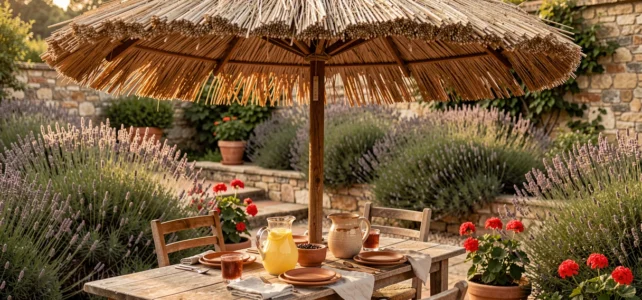
A thatched parasol placed in the middle of a garden immediately changes the perception of space. The light filters differently, the shadow produced is softer than with synthetic fabric, and the material itself ages with the surrounding vegetation. This type of parasol is not limited to blocking the sun: it contributes to the overall atmosphere of the garden, just like furniture or planting.
Thermal comfort under a thatched parasol: what synthetic fabric does not do
Have you ever noticed the difference in heat felt under a textile parasol versus under a thatched structure? Under a polyester fabric, the air stagnates and the temperature rises quickly. The thatch, on the other hand, allows micro-currents of air to circulate through its woven fibers.
This phenomenon can be explained simply: thatch does not form a waterproof surface. The gaps between the strands allow warm air to escape upwards, while the shade remains dense below. The result is a shaded area where the perceived temperature is significantly lower than under a traditional parasol of the same diameter.
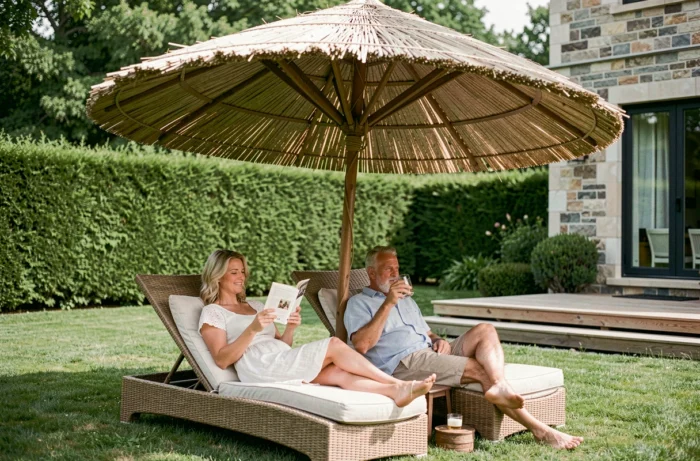
The filtered light also plays a role. Unlike an opaque fabric that plunges the space into a harsh shadow, thatch diffuses a golden clarity, pleasant for reading or dining without needing additional lighting during the day. To choose a thatched parasol suitable for your use, this light filtration criterion deserves as much attention as the diameter or height of the pole.
Natural thatch and fire regulations: a technical point often overlooked
Raw thatch is a combustible material. In a private garden, this usually does not pose a regulatory constraint. The situation changes radically if the parasol is installed in a public place: guesthouse, bed and breakfast, restaurant with terrace, outdoor spa.
Establishments open to the public (ERP) must comply with the M1 standard for decorative and shading materials. This requirement applies regardless of the category of the establishment. An untreated thatched parasol does not meet this standard.
Fire retardant treatments for thatch and straw
Liquid fire retardant solutions, applied by spraying, can make a thatched parasol compliant with fire safety requirements. This process, initially developed for artificial green walls and interior decorations, is now used by some installers of outdoor “bamboo hut” structures.
The protocol requires documenting the date of treatment, the product used, and technical justifications, in order to present them during a safety commission inspection. A fire retardant treatment is renewed periodically, as exposure to the elements degrades the protection over the seasons.
For strictly private use, this treatment remains optional. However, it can provide reassurance if the parasol is close to a barbecue or fire pit.
Thatched parasol and durability: bamboo, reed, palm
The term “thatched parasol” actually encompasses several plant materials with very different properties. Understanding these distinctions avoids disappointments after one or two seasons of use.
- Reed (including Camargue reed) offers good natural rigidity and withstands moisture well. Its color gradually turns to a silvery gray over time, which some appreciate and others find off-putting.
- Bamboo, often used for the structure of the pole and ribs, provides superior mechanical strength compared to most softwoods. Its density also makes it heavier, improving wind stability.
- Palm leaves (raffia, date palm) give the most “tropical” appearance. They are more flexible, lighter, but also more prone to fraying if not regularly maintained.
The choice of material depends as much on the local climate as on the desired style. In a windy region, a bamboo pole with reed covering will be more durable than a lightweight structure made of raffia.
Natural thatch or synthetic imitation: the impact on the garden’s ambiance
Imitations made of polyethylene or woven PVC replicate the appearance of thatch without its maintenance constraints. In a catalog, the difference can sometimes be subtle. In a real-life situation, it is glaring.
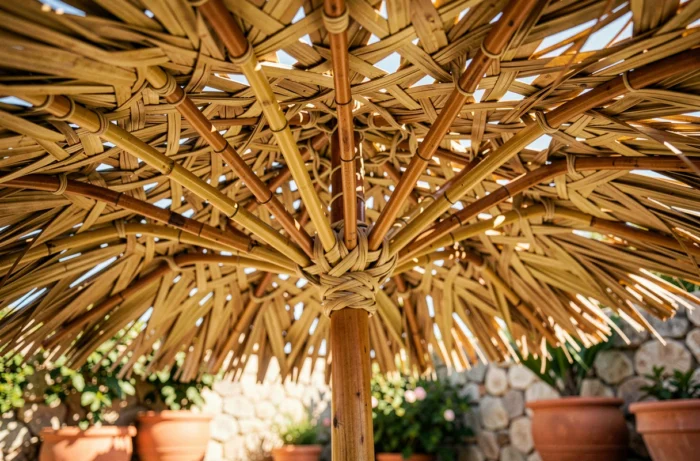
Natural thatch ages, and that is precisely what creates its charm. The fibers patina, the color evolves with the seasons, and the parasol gradually integrates into the garden like a raw wood pergola would. A synthetic imitation retains the same uniform hue year after year, which eventually makes it visually out of place in a vibrant plant environment.
The imitation has a real advantage in only one regard: it is not susceptible to mold or insects. For a parasol that remains outside all year without a protective cover, this is a valid argument.
Maintenance of a natural thatched parasol
A natural thatched parasol requires little, but regularly. A dry brushing at the beginning and end of the season is enough to remove dust and plant debris. In case of localized mold, a mixture of water and white vinegar applied with a brush solves the problem without damaging the fibers.
Storing the parasol in a sheltered place during winter extends its lifespan by several seasons. A garage, a garden shed, or even a breathable cover will do the trick. Waterproof covers should be avoided: they trap moisture and accelerate degradation.
The thatched parasol is not the simplest or most durable choice in absolute terms. However, it is the only one that brings to the garden a quality of light, texture, and visual presence that no fabric stretched over metal ribs can replicate. The decision criterion often boils down to this: accept a living material, with its imperfections, or prefer the consistency of an industrial product.