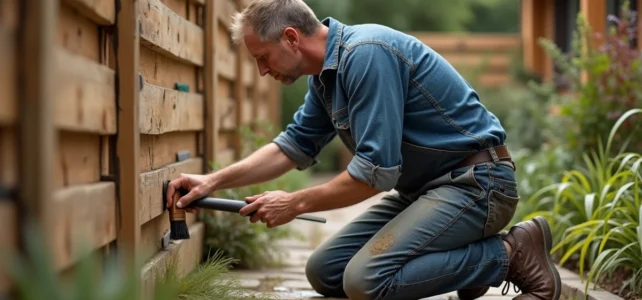
A saturator and a stain both protect exterior wood, but their mode of action is radically different. The former penetrates the fibers, while the latter forms a film on the surface. This choice affects the durability, maintenance, and final appearance of your terraces, cladding, and fences.
Protective film or impregnation: the mechanism that changes everything
The stain is a film-forming product that deposits a protective layer on the surface of the wood. This film acts as a barrier against water and UV rays while allowing the grain to remain visible. The saturator, on the other hand, works by impregnation: it penetrates the fibers without creating a film, nourishing them deeply with oils or resins.
This technical distinction has direct consequences. A stain film eventually cracks and peels due to the dimensional variations of the wood (expansion, contraction). When this film degrades, sanding is required before reapplying a layer. The saturator, however, wears away through gradual erosion without ever peeling, which significantly simplifies maintenance cycles.
We observe that this property makes the saturator a more suitable product for woods subjected to strong mechanical stresses (foot traffic, water stagnation). The stain remains relevant where the wood works little and where a more satin or filled appearance is desired.
To delve deeper into the difference between stain and saturator for wood, it is also necessary to consider the orientation of the surfaces, which modifies the stresses applied to the finishing product.
Horizontal or vertical surface: the determining choice criterion
Professionals now almost systematically recommend the saturator for horizontal surfaces (terrace, decking, pool coping) and the stain for vertical surfaces (cladding, fence, shutters). This is not an arbitrary convention.
On a horizontal plane, water stagnates. A stain film subjected to repeated puddles detaches more quickly, and UV rays strike perpendicularly, accelerating its degradation. The saturator, which has no film to protect, withstands these aggressions without delaminating. On a vertical plane, rainwater runs off and does not stagnate. The stain film lasts much longer, and its satin appearance enhances facades and joinery.
A carport or garden shed illustrates this mixed logic well: the decking on the ground receives a saturator, while the vertical posts and beams can receive a stain.
Field maintenance: actual cycles depending on exposure
Product data sheets often announce protection durations of several years. In practice, the frequency of maintenance varies significantly depending on exposure and the type of surface.
- Highly exposed wooden terrace (full south, without cover): an annual cycle combining a wood cleaner followed by a saturator is the standard maintenance recommended by several manufacturers and installers.
- Cladding or fence under moderate exposure: an application of stain every three to five years is generally sufficient to maintain the original color.
- Semi-sheltered structures (carport, pergola, shed): an application of saturator or stain every three to five years maintains adequate protection, as the wood is partially protected from direct weather.
These discrepancies show that frequency depends less on the chosen product than on the combination of surface/exposure/wood species. A south-facing softwood terrace will always be more demanding than a Douglas fir cladding under a roof overhang.
Surface preparation and product compatibility
You cannot apply a saturator on wood that has already been stained without prior stripping. The residual film of the stain prevents the saturator from penetrating the fibers, making it ineffective. The reverse poses fewer technical problems, but we recommend in all cases sanding or complete stripping before changing product families.
A new or freshly sanded wood can accept either finish indiscriminately. On gray wood, using a wood cleaner (often based on oxalic acid) restores the light color and opens the pores before application. This step is particularly useful before applying a saturator, as its effectiveness directly depends on its ability to penetrate.
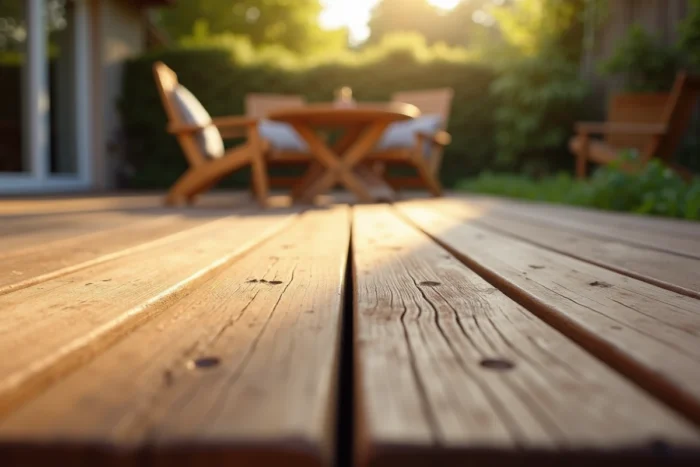
For dense exotic woods (ipe, cumaru, teak), the saturator remains the technical reference choice. These tight-grained species do not adhere well to stain films, which end up peeling off within a few months. A saturator suitable for exotic woods, often formulated with specific oils, penetrates despite the density of the wood and ensures long-lasting protection.
Aesthetic result: natural look versus worked finish
The saturator maintains a matte and natural appearance close to raw wood. It slightly enhances the color without altering the texture to the touch. The stain, depending on its formulation, can provide a satin finish, or even a slightly glossy one, with a smoother feel.
In terms of color palette, stains offer a wider range of shades, including dark or colored tones that stray from the natural wood look. Saturators generally remain in wood tones (honey, teak, oak) or clear. If you are looking to heavily tint a cladding or shutters, the stain will be more suitable.
This aesthetic criterion should not take precedence over the technical criterion. Applying a stain on a terrace for its dark color amounts to sacrificing durability for appearance. The film will degrade quickly underfoot and in the weather, imposing tedious and frequent maintenance.
The choice between saturator and stain boils down to three questions: is the surface horizontal or vertical, what type of wood is being used, and what level of maintenance are you willing to undertake? By answering these three points, the technical answer becomes clear.