
On a traditional golf course, the precision of putting and reading the green takes center stage. Long drive flips this logic: only one action matters, sending the ball as far as possible down a defined corridor. Swings regularly exceed 220 km/h, and the balls cover distances that most amateur golfers struggle to imagine.
This discipline attracts an audience that far exceeds the circle of traditional practitioners because it combines athletic preparation, technical skill, and raw spectacle.
Long drive equipment: clubs designed for pure speed
Have you ever compared a standard driver with that of a long drive competitor? The difference is striking. The shafts used in competition are longer, often around 48 inches, compared to 45 for a course driver. This extra length increases the speed of the clubhead at the moment of impact.
The choice of shaft is not limited to length. The flexibility of the shaft affects the transfer of energy to the ball. A shaft that is too stiff for the player’s profile absorbs some of the power. If it’s too flexible, it becomes inaccurate and the ball goes out of the validation corridor. Competitors test several combinations before each season to find the optimal setting.
As for the clubhead, the loft is generally lower than on a standard driver, sometimes below 6 degrees. The goal is to produce a tight trajectory that maximizes roll on the ground after landing. Because in long drive, the total distance includes the rolling phase after impact. The ball simply needs to stay in the corridor, which typically measures between 40 and 60 meters wide.
The Belgian long drive community is gradually organizing around dedicated structures, and enthusiasts can follow the news of this discipline on longdriversbelgium.be, which brings together competitions and technical resources.

Physical preparation for long drive: athlete training
Long drive rewards not only technique. Competitors follow physical preparation programs comparable to those of power sports athletes. Why such an investment? Because swing speed directly depends on the body’s ability to generate and transfer force in a fraction of a second.
Hip rotation triggers the entire power chain. A player with limited hip mobility compensates with the upper body, which reduces speed and increases the risk of injury. Therefore, training primarily targets:
- The mobility of the thoracic spine and hips, to allow for complete rotation without compensation
- The explosive power of the legs and core, developed through plyometric exercises (jumps, medicine ball throws)
- The stability of the wrist and forearm, intensely engaged during impact at over 200 km/h
Many competitors come from other sports: baseball, hockey, martial arts. Their ability to produce rotational speed gives them a natural advantage. But without specific training to adapt to the golf swing, this raw power can be lost in uncontrolled trajectories.
Format of a long drive competition: rules and structure
The format of a long drive event is simple to understand, even for a spectator who has never touched a club. Each competitor has several attempts, often between six and eight balls. Only the best shot that lands in the corridor is counted.
A shot is valid only if the ball lands and comes to a stop inside the marked corridor. Hitting far is not enough: a drive of 380 meters that goes out of bounds does not count. This constraint forces players to find a balance between maximum power and directional control.
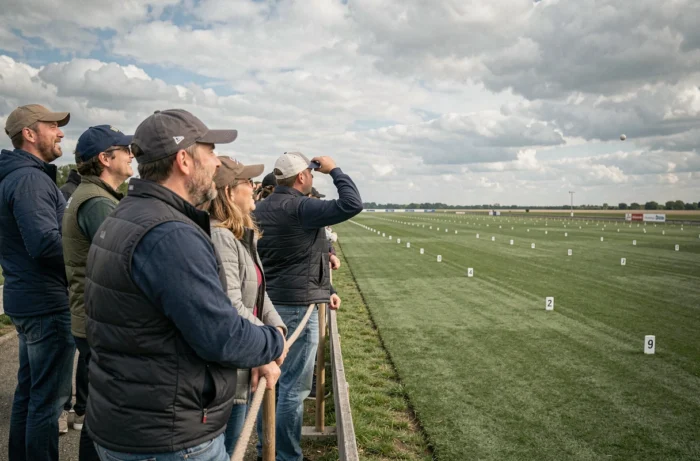
Competitions often take place over several elimination rounds. The early rounds gather a large number of participants. The best advance to head-to-head final phases, where the pressure mounts. The audience, often gathered behind the tee, sees the balls take off with a characteristic sharp sound. The atmosphere resembles more of a sporting event than a traditional golf tournament.
Junior division and television coverage
Long drive is evolving towards broader structuring. The public course at Wildcreek, in Reno, has been selected as the host for the Pinnacle World Long Drive Championship for several editions, at least until 2028. Chris Mazzaferri has notably spearheaded the creation of a junior division integrated into the same television framework as the professionals, on Golf Channel. This opening to young hitters changes the image of the discipline: it is no longer reserved for powerful adults.
Long drive and recreational golf: natural bridges
The rise in popularity of driving ranges, indoor simulators, and complexes like Topgolf creates a pool of players attracted by the joy of hitting far, without necessarily practicing golf on a course. Long drive capitalizes on this desire for power and spectacle.
An amateur golfer who frequents a simulator or practice range can discover long drive without radically changing their habits. The difference lies in the intensity of preparation and the equipment used. But the basic action remains a driver swing, making the transition accessible.
This permeability between recreational golf and long drive explains the growth of the discipline in countries where golf is diversifying. Federations are gradually integrating long drive into their calendars, and mixed events combine long drive competitions with public initiation sessions.
Long drive does not replace course golf. It offers a different perspective, focused on a moment of raw power. For spectators as well as practitioners, it is this intensity compressed into a few seconds of swing that makes each hit memorable.