
On Snapchat, the yellow heart 💛 appears next to a contact’s username without warning. It can disappear just as quickly. Behind this small symbol lies an algorithmic mechanism that quantifies your exchanges and ranks your relationships. Understanding how it works allows you to decode part of the social logic integrated into the app.
How the Snapchat algorithm assigns the yellow heart to a contact
The yellow heart carries the official label “Besties.” It indicates that you and a contact are each other’s number one best friend. Specifically, you send more snaps to this person than to anyone else, and vice versa.
The algorithm only considers photo and video snaps sent privately. Text messages in chat, published stories, or group snaps do not count in this calculation. The ranking updates continuously, without a known fixed cycle.
If you want to delve deeper into what the yellow heart means on Snapchat, the status is based on a simple criterion: the reciprocity of the volume of visual exchanges between two accounts.
A rarely mentioned point: the yellow heart can appear within a few hours if two users send each other a large number of snaps over a short period, even without a prior exchange history. The status does not require a minimum duration.

From the yellow heart to the red heart and then pink: the progression of Snapchat emojis
The yellow heart is just the first step in a sequence. If the reciprocal best friend status is maintained for at least two weeks, the yellow heart transforms into a red heart ❤, dubbed “BFF”.
After two consecutive months in this same status, the red heart gives way to two pink hearts 💕, the rank “Super BFF.” This progression serves as an indicator of relational consistency.
What causes the loss of the yellow heart
The yellow heart disappears as soon as one of the two contacts sends more snaps to a third person. It only takes one of them to change their sending habits for a short period for the algorithm to recalculate the ranking.
The loss of the yellow heart generates no notification. You only notice it by checking your friends list. However, the hourglass ⏳ may appear on streaks to signal a risk of breaking the series, which is a distinct mechanism.
Customize or hide the yellow heart in Snapchat settings
Snapchat allows you to replace the yellow heart with any other emoji for the “Besties” category. The visual symbol changes, but the algorithmic calculation remains the same. Your number one contact retains their rank even if you display a cactus instead of the heart.
The path to the settings has recently changed. On iOS, customization can now be found in:
- App & Privacy, then My App, then Customize My App, then Friend Emojis
- On Android, the menu is titled Customize Emojis, accessible from the app settings
- It is also possible to completely disable friend emojis, which removes all hearts and symbols from the contact list
Disabling hides the display without altering the ranking logic in the background. If you reactivate the emojis later, the yellow heart (or red, or pink) reappears according to the current status of your exchanges.
The Snapchat yellow heart compared to other relational emojis: practical distinctions
The yellow heart sometimes gets confused with other symbols in users’ minds. The smiling face 😊 simply indicates that someone is one of your best friends, without confirmed reciprocity. The yellow heart requires total reciprocity at rank number one.
The grimacing face 😬 indicates that your number one best friend is also that of another contact. The face with sunglasses 😎 appears when you share a mutual best friend in your respective lists.
- 💛 Yellow heart: reciprocal number one best friend, no minimum duration required
- ❤ Red heart: same status maintained for at least two consecutive weeks
- 💕 Pink hearts: same status maintained for at least two consecutive months
- 😊 Smiling face: one of your best friends, without mandatory reciprocity at rank number one
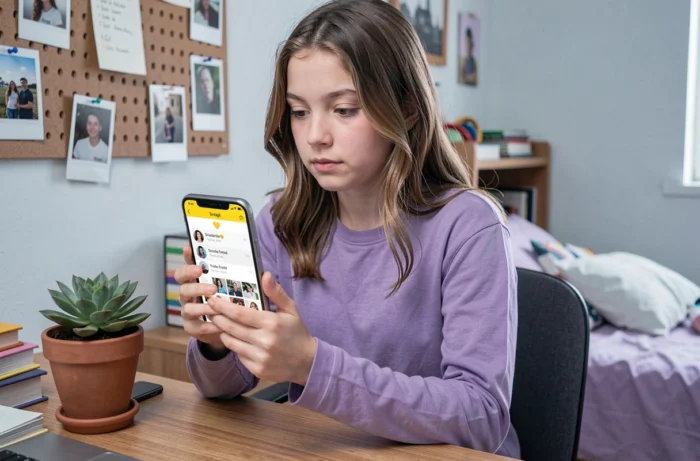
Private snaps and story activity: a frequent confusion
Story views and responses to stories do not weigh in the calculation of the best friends ranking. Two users who interact exclusively via stories will never trigger the appearance of the yellow heart, even with daily exchanges.
Only photo or video snaps sent directly to a contact feed the algorithm. Text messages in chat are also excluded from the count. This distinction explains why some users who are very active on stories never see a yellow heart appear next to contacts with whom they think they exchange a lot.
The Snapchat yellow heart remains a raw indicator of the volume of private visual exchanges between two accounts. It does not measure the quality of conversations, the time spent together on the app, or public interactions. Its fully automated mechanics reflect a sending habit more than a real closeness. Keeping this nuance in mind helps avoid overinterpreting an emoji that, at its core, only counts snaps.