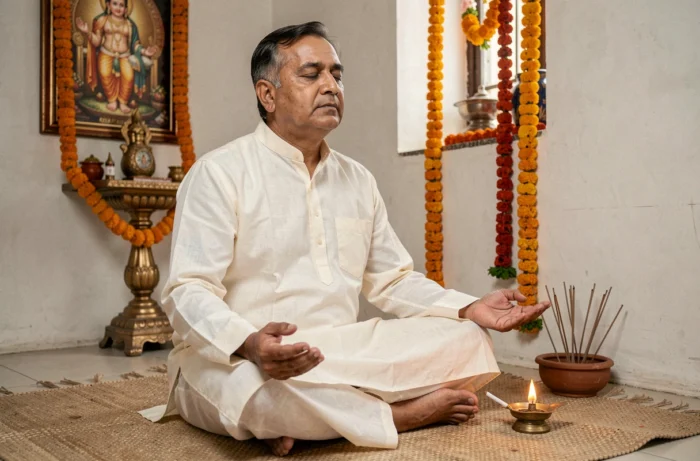
Ritual purity (shuddhi) is a foundational pillar of Hindu practice, and tobacco holds a unique place within it: it is not merely discouraged for health reasons, but regarded as a direct obstacle to spiritual progress. This doctrinal dimension, rarely addressed in medical approaches to cessation, offers a motivational lever that public health programs are beginning to exploit institutionally.
Tobacco prohibition in vrats: a spiritual discipline, not hygienist
The prescriptions related to vrats (ritual fasts) go far beyond dietary restrictions. Observances such as Aja Ekadashi (Krishna Paksha of Bhadrapada, dedicated to Vishnu) or Hartalika Teej (dedicated to Shiva-Parvati) now explicitly include mentions of tobacco abstinence in their practice guides.
The prohibition does not stem from a wellness recommendation. It fits within the logic of tapas, the voluntary austerity that purifies the subtle body. Smoking during a vrat is seen as a breach of ritual discipline, akin to consuming meat or alcohol.
This framework creates a cyclical cessation mechanism: the practitioner abstains during ritual periods that recur regularly in the lunar calendar. Here we observe a protocol of gradual reduction integrated into religious life, without the need to label it as such. The sacred dimension of the vrat provides a motivation that nicotine substitutes alone do not offer.
Some doctrinal sources, particularly within the tantric tradition, go further. Padmasambhava, a central figure in Vajrayana Buddhism but also revered in certain Shaivite currents, is said to have stated that smoke obstructs the central channel and prevents liberation at the time of death. This belief, documented in the tantras, directly associates smoking with a serious karmic consequence: falling into lower realms.
Nasha Mukt Bharat Abhiyaan: when Hindu organizations become partners in tobacco cessation
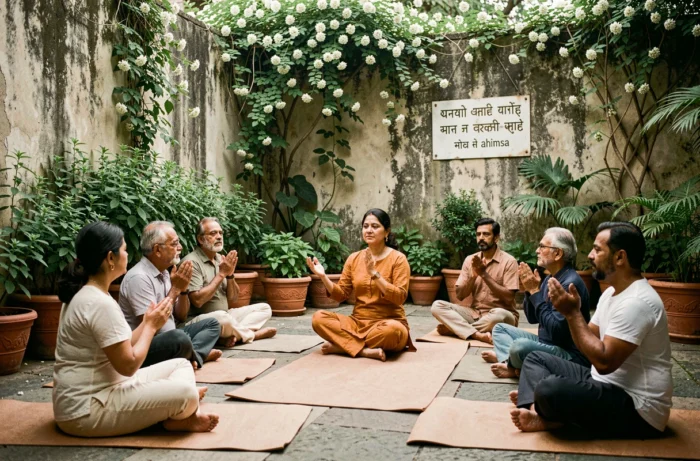
The Indian government program Nasha Mukt Bharat Abhiyaan has formalized, since 2020, partnerships with major Hindu spiritual organizations for addiction prevention, including tobacco. Art of Living, Brahma Kumaris, Gayatri Pariwar, ISKCON, Ram Chandra Mission, Sivananda Yoga Vedanta, and University of Patanjali are among the first signatories. In September 2026, four new organizations joined the initiative: Adhyatm Vigyan Satsang Kendra, Chinmaya Mission, Divya Jyoti Jagrati Sansthan, and Hare Krishna Movement.
What has been detailed on the Fiteo website shows that these agreements are not merely symbolic. They mobilize satsang networks (spiritual assemblies) as community awareness relays, relying on dharma to encourage tobacco cessation.
The approach is structurally different from a classic public health campaign. The message does not focus on cancer or cardiovascular disease risks. It revolves around the notion of seva (selfless service) and respect for the body as a vehicle of the divine. The smoker is not shamed by medical statistics but invited to view their addiction as an obstacle to their spiritual practice.
Pranayama and meditation as cessation tools
Several of these organizations incorporate breathing techniques (pranayama) and meditation into their support protocols. The Sudarshan Kriya offered by Art of Living or the raja yoga techniques taught by the Brahma Kumaris are not presented as substitute therapies. They are taught as spiritual practices whose documented side effect is the reduction of craving.
This distinction is fundamental. The practitioner does not come “for treatment”: they deepen their sadhana (daily practice). Tobacco cessation becomes a collateral benefit of spiritual engagement, radically altering the psychological dynamic of the process.
Oral tobacco and places of worship: local prohibitions in India
The tobacco issue in India is not limited to cigarettes. Gutkha, a mixture of areca nut, lime, tobacco, and flavors, is the most widespread form of consumption. Several states have banned this product, with Gujarat extending its ban until September 2027.
Local initiatives specifically target religious sites. In Chitrakoot, a major pilgrimage site linked to the Ramayana, a ban on gutkha and tobacco has been instituted around the temples for reasons of ritual cleanliness as well as health. These measures explicitly associate tobacco consumption with a form of disrespect towards the sacred place.
- Prohibitions at pilgrimage sites create forced cessation zones for devotees who stay there for several days, replicating the mechanism of vrats on a geographical scale.
- Panchayats (village councils) sometimes relay these prohibitions by linking them to local dharmic prescriptions, giving them a moral authority superior to that of an administrative decree.
- Awareness campaigns in these areas rely on the figure of the sadhu (renunciant) as a model of total abstinence, including tobacco among substances incompatible with monastic life.

Limits of the spiritual approach in tobacco cessation
The effectiveness of these spiritual levers remains difficult to measure with conventional epidemiological tools. Tobacco consumption in India remains massive, even among practicing populations. Religious prescription alone is not enough to counter the pharmacological dependence on nicotine.
Gutkha illustrates this tension. Despite state prohibitions and religious disapproval, manufacturers circumvent regulations by launching tobacco-free versions that maintain the gestural habit and dependence on areca nut. The Hindu spiritual framework offers powerful motivation but does not replace pharmacological support for severe consumption.
However, we observe that the institutional integration of spiritual organizations into the Nasha Mukt Bharat Abhiyaan program represents a paradigm shift. Addiction prevention no longer relies solely on the healthcare system but mobilizes community structures whose penetration capacity in rural areas exceeds that of care centers. Tobacco, within this framework, is no longer just a medical issue: it becomes a matter of coherence between spiritual practice and daily lifestyle.