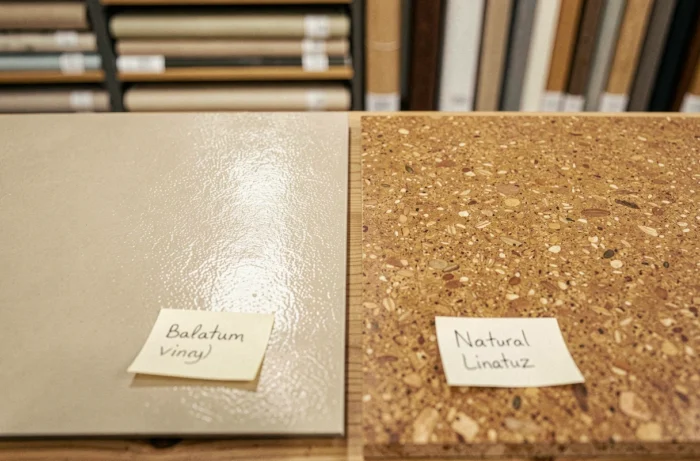
The market for flexible floor coverings maintains a persistent confusion between linoleum and vinyl. These two terms refer to products with radically different compositions, health performance, and lifespans. Since 2013, French regulations have mandated labeling for volatile organic compound (VOC) emissions for any building material intended for indoor use, including floor coverings and adhesives. This framework classifies products from A+ (very low emissions) to C (high emissions), a criterion that most online comparisons do not incorporate.
VOC Emissions and Regulatory Labeling: What the A+ to C Classification Says
The mandatory VOC label since September 1, 2013, applies to all flexible flooring sold in France. It measures emissions of formaldehyde, acetaldehyde, toluene, and eight other volatile substances in indoor air. A product rated A+ emits fewer pollutants than a product rated B or C.
Natural linoleum, made from linseed oil, wood flour, natural resin, and jute fabric, typically receives an A+ rating. Its composition excludes synthetic plasticizers responsible for prolonged emissions. Original linoleum, made from bitumen-impregnated cardboard, and its low-end PVC successors often contain traditional plasticizers that negatively impact their VOC rating.
Understanding the difference between linoleum and natural linoleum starts with reading this label, which is present on the packaging or the manufacturer’s technical data sheet. A floor rated A+ in a child’s room does not produce the same indoor air quality as a floor rated B in the same room.
Composition of Natural Linoleum and Vinyl: Two Incomparable Industries
Authentic linoleum is based on a process invented in the mid-19th century. Linseed oil is oxidized to form a flexible cement, mixed with wood flour, cork powder, and mineral pigments, and then calendered onto jute fabric. No petrochemical derivatives are included in this recipe. Professional ranges like Forbo’s Marmoleum illustrate this industry, with renewable raw materials over 90% according to the manufacturer.
The historical vinyl, created in the 1920s by the Papeteries de Genval in Belgium, used cardboard impregnated with bitumen or asphalt. This product has nearly disappeared from shelves. What is now commonly referred to as “vinyl” actually refers to a low-end PVC floor, rolled out, with a thin wear layer printed with decorative patterns.
This substitution of vocabulary poses a concrete problem: a buyer asking for “vinyl” in a store receives a vinyl product whose composition, durability, and health profile have nothing to do with natural linoleum.
UPEC Classification and Durability: An Often Ignored Indicator
The UPEC classification, specific to the French market, evaluates four criteria: Wear, Indentation, Water resistance, and Chemical resistance. It helps verify whether a covering is suitable for the intended use in a given room, according to the CSTB specifications.
- A good quality natural linoleum typically achieves a U3 P2 rating, making it suitable for high-traffic areas like a living room or hallway.
- A low-end PVC floor type “vinyl” often falls in U2 P2, with a thinner wear layer that limits its longevity in high-demand areas.
- Water resistance (E) remains a weak point for linoleum: its jute base does not tolerate stagnant moisture well, which excludes its use in a bathroom or laundry room without specific precautions.
The UPEC classification is included in the CSTB technical opinions, available online. Checking this classification before purchase helps avoid installing an unsuitable floor for the actual traffic of the room.
Healthy Flooring in a Child’s Room or Nursery: What Selection Criteria
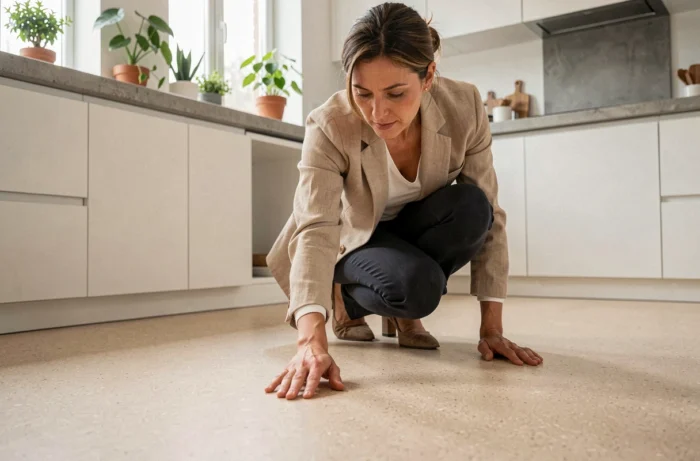
Rooms occupied by young children concentrate health concerns. A child spends time on the floor, puts objects in their mouth, and breathes air that is more polluted at floor level than at adult height. Public health guides recommend prioritizing materials with very low VOC emissions, rated A+, and avoiding solvent-based adhesives during installation.
Natural linoleum meets these criteria when installed with a solvent-free adhesive, also rated A+. Its surface, naturally bacteriostatic due to the continuous oxidation of linseed oil, limits microbial proliferation without added chemical treatment.
Recent mid-range or high-end PVC floors can also display an A+ rating. Field reports vary on this point: some installers report a persistent odor during installation on low-end vinyl ranges, which is absent on linoleum. The label alone is not enough to guarantee real olfactory comfort in the weeks following installation.
Cost and Lifespan: Long-Term Calculation
A low-end PVC floor costs significantly less per square meter than natural linoleum. The price difference can range from one to three times depending on the ranges. This initial difference becomes relative over time.
- A well-maintained natural linoleum retains its properties for several decades. Some installations in collective settings exceed thirty years of service.
- A low-end PVC floor shows signs of wear (yellowing, tearing, delamination) much earlier, often before ten years in a regularly used room.
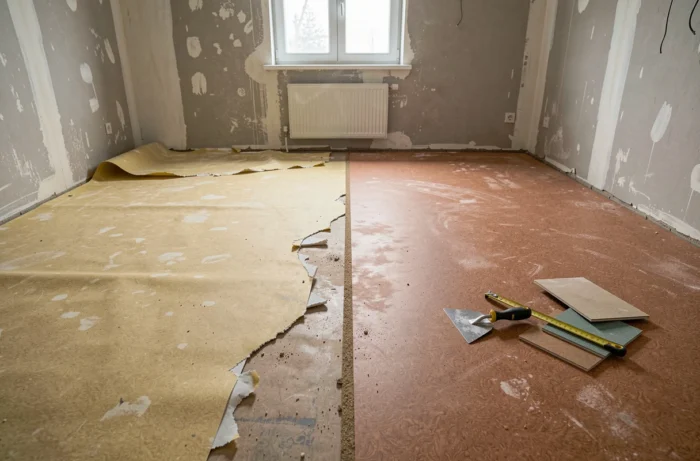
- The early replacement of a cheap floor generates additional costs: removal, substrate preparation, reinstallation, and new exposure to VOCs during the adhesive drying phase.
The overall cost also includes the end-of-life question. Linoleum, biodegradable, does not produce plastic waste. PVC requires a specific recycling stream, which is still underdeveloped for flexible flooring in France.
Choosing a floor covering for health reasons involves considering at least three data points: the VOC label of the floor, that of the adhesive used, and the UPEC classification suitable for the room. A natural linoleum rated A+ installed with an A+ adhesive remains the best-documented combination to limit indoor pollutants, provided its limitations regarding moisture are accepted.